
Book Ban Controversy
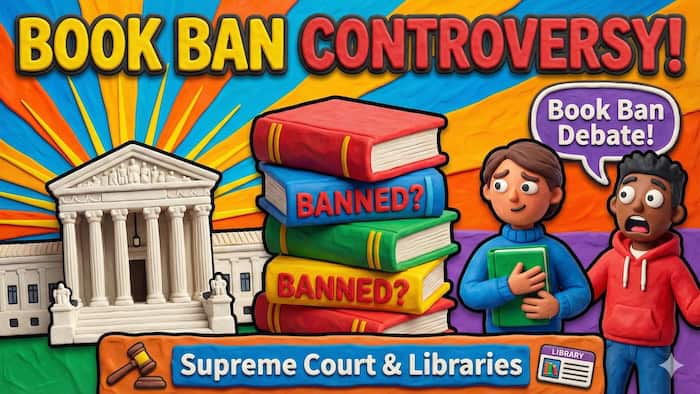
Thomas: The Supreme Court has decided not to weigh in on what is being called a book ban case. Jonathan, what is the latest on this?
Jonathan: Starting in May 2025, the Fifth Circuit Court, which covers Texas, Mississippi, and Louisiana, ruled that government officials or librarians could exclude or remove books from library shelves for ideological, political, or religious reasons. The court asserted that library collections constitute government speech and therefore are not protected under the First Amendment.
In October, major publishers, including the Big Five, filed an amicus brief with the Supreme Court in support of the plaintiff in Little v. Llano. Their goal was to overturn the Fifth Circuit’s ruling and prevent what they describe as book banning.
On December 8, the Supreme Court declined to hear the case. No reason was given for the decision. It may have been related to procedural issues. The Big Five have indicated they intend to continue pursuing the matter in other courts, with the goal of building a strong enough precedent to renew their challenge and eventually secure a favorable Supreme Court ruling. Thomas, what do you think?
Is removing a book from a library the same as banning it?
Thomas: This is not a real book ban. Librarians constantly make decisions about which books to offer for free on library shelves. They buy new books and remove others all the time. Deciding whether a book is stocked, or choosing not to stock it at all, is not a book ban.
A book ban is preventing a book from being sold to people who want to buy it with their own money. You do not have a right to have the government purchase a book and place it on the shelves of your local library.
This is especially true in schools. A school librarian can say a book is not appropriate for children. That is what these disputes are actually about, keeping pornographic material away from minors. Much of the media coverage ignores that reality. They do not acknowledge that the concern is about exposing very young children to explicit material.
This is also why I get frustrated with certain author organizations. The court cases they prioritize tend to focus on protecting adult content, specifically adult content being made accessible to children.
This is not a book ban case, even though many outlets frame it that way. They intentionally blur the distinction between the government buying a book and an individual buying a book.
It is similar to SNAP benefits and junk food. You can buy junk food with your own money. That is not illegal. But in some states, you cannot use government money to buy junk food. That is not banning Twinkies. If you want to buy them with your own money, you can. The same logic applies here.
How is the term “book banning” being used?
Jonathan: Calling this book banning is a way to reframe the issue to make one position sound more sympathetic. It would be like bringing another woman home to your wife and saying, “What, are you against love?” That is not the real issue being discussed.
Here, no one is against books. The concern is about problematic content being put in front of children who should not have access to it. Kids do not need exposure to material that sexualizes them, radicalizes them, or amplifies fringe agendas far beyond their actual scope.
I recognize this is a double-edged issue and that it can cut both ways. Still, I support libraries reflecting the values of the majority of their communities. You cannot eliminate agendas from books entirely, but library collections should broadly align with the community rather than pushing cultural shifts. That push is what sparks these ongoing conflicts and unproductive media narratives.
Are public libraries still viable?
Thomas: I do not really believe in public libraries anymore because of how ideologically captured they have become. Attempts by democratic processes to reassert influence over libraries are often resisted by librarians who are deeply entrenched ideologically.
I think we should move back toward private libraries. Many churches used to have their own libraries. Running a library with donated or leftover books is not that difficult.
Jonathan: I agree. I like the little neighborhood book boxes where people take a book and leave a book. Those work very well. In my area, Tucson has a lot of them, and they are popular because they are crowdsourced by the community. They naturally reflect the values of the people who live there.
Matt Dinniman Announces Release of Parade of Horribles

Thomas: Matt Dinniman is in the news for his book A Parade of Horribles. We do not normally cover individual authors or books on this publishing show. Jonathan, how did Matt Dinniman make it so high on our list of stories today?
Jonathan: First, authors should study Matt Dinniman’s rise. He made it big and did several things many authors want to do.
In this case, the next installment of his Dungeon Crawler Carl series, which is wildly popular, is set to release in May 2026. That release date was just announced. He retains the ebook rights for self-publishing, which means he keeps all of the ebook and Kindle Unlimited revenue.
Paperbacks will go through Grim Oak Press, and hardcovers will go through Ace Books under Penguin Random House. He has multiple deals in place, including Walmart distribution through those publishers, which is why this is notable. His most recent release reached number two on The New York Times bestseller list.
The most interesting detail, and what made this newsworthy for me, is that audiobooks outsold both ebooks and physical formats.
Why are the audiobooks outperforming other formats?
Thomas: That is not surprising. This connects to a story we discussed a few weeks ago about the three kinds of audiobooks, similar to hardbacks, paperbacks, and mass market editions.
The Dungeon Crawler Carl audiobooks are the premium hardback equivalent. They have high production values, multiple voices, and guest performers. At one point, the Critical Drinker plays a cranky dwarf.
Was it a great audiobook performance? No. Did I enjoy it? Absolutely. It was a minor character, and I will spoil it slightly by saying there is a reason he is not in the next book.
For a cameo by a well-known YouTuber, it was very fun. That extra production value costs real money. The production on the Dungeon Crawler Carl audiobooks is extremely expensive, and a lot was invested in them. When you have a story as gripping as these books, that additional production value can significantly increase sales, even on digital shelves.
Jonathan: At some point, I want to do a zeitgeist segment specifically on the Dungeon Crawler Carl series. LitRPG was a small subgenre, and Dungeon Crawler Carl broke it open. That was a big deal.
Thomas: It was the first to escape containment. Is it the best LitRPG? No. Is it the most appealing to readers who do not normally read LitRPG? Yes. Part of that appeal is that it is genuinely funny, and there is not much humorous fiction available.
Author Arsenal Releases Its First Episode Saturday
Jonathan: The first tutorial episode of Author Arsenal, covering the formatting tool Vellum, is now on YouTube. I’ll have some shorts up so you can subscribe to the channel and get a teaser of what the style will be like. I’m excited for everyone to check it out!
In addition, I will be starting the Arsenal Writing Challenge January 5, where participants will write a book in the month of January. This challenge will include classes on planning, discipline, writer’s block, dealing with distractions and other topics authors struggle with in the drafting process. Wordcounts will be due by 8AM the following morning for each weekday, and live writing sprint sessions with Yours Truly for motivation.
Learn more about the Author Arsenal.
Amazon Removes Kindle DRM Requirements

Thomas: We have a lot of major Amazon news, and the first item is honestly shocking to me. Amazon is removing DRM requirements for certain Kindle books. Jonathan, what is going on here?
Jonathan: Amazon is allowing certain Kindle ebooks to be distributed without digital rights management and made available in EPUB and PDF formats starting in January 2026. This update was announced through KDP documentation and reported across multiple tech news outlets.
The change allows readers to purchase DRM-free titles and use them on devices and applications outside the Kindle ecosystem. That is surprising, given how aggressively Amazon has historically protected its platform.
What is DRM and why does it matter?
Thomas: Let’s explain what DRM is, because this is a big deal and many people do not fully understand it. DRM was initially invented to protect audio files. One of its first mass-market uses was with digital music.
When you bought an MP3 or AAC file from iTunes in the early days, every time you played that file or activated it on a device, iTunes contacted Apple’s servers to verify that it was a legal purchase. If you shared the file with a friend, their copy would not play on their device.
If you are not very technical, that sounds reasonable. We do not want people pirating content or spreading unauthorized copies. There is also a very famous letter Steve Jobs wrote making the case against DRM. You can look it up. In it, he explains that DRM creates a poor customer experience and tends to break frequently.
If there is an internet issue, something you legally purchased may suddenly stop working. There are many cases where people bought content legally, the company went out of business, and the validation servers were shut down. Servers cost money to run forever, and when the money stops, the servers stop. When that happens, everything protected by DRM eventually fails.
DRM inevitably creates friction. It prevents people from using content they purchased in legal ways, even though it also prevents illegal use. Steve Jobs’s letter was influential enough that DRM largely disappeared from the music industry. You can now buy non-DRM music from Apple and elsewhere.
One place DRM did not disappear is books. In fact, Amazon has added more and more restrictions over time, and I have found that personally frustrating.
How does DRM affect readers and authors today?
Thomas: Recently, my book club has been reading The Making of a Modern Day Knight, which is an excellent book. It was written in the 1990s and does not have an audiobook. I wanted to create a discussion guide and use AI to help with that, but there was no good way to feed the book into an AI tool because of DRM restrictions.
I ended up going into the darker corners of the internet to piece together a chapter outline and discussion questions. The book is popular enough that the results were acceptable, but I would have much preferred to upload a DRM-free copy and simply say, “Generate discussion questions for this book,” the same way authors can do with their own books in the Patron Toolbox.
Instead, I had to use a workaround. This is really an AI story. I believe Amazon is making this change to allow readers to use the books they have purchased alongside AI tools.
It also makes it easier for companies like Anthropic to buy digital copies of books legally. They were involved in a major court case and were told they could not pirate books. But obtaining digital copies legally is difficult when DRM forces companies to scan physical books, which is expensive and inefficient.
Amazon would rather sell an ebook for $10 or $20 to AI companies than have thousands of paper books printed, scanned, and destroyed. That process is wasteful and inefficient.
Can authors stop AI from using their books?
Jonathan: If you are worried about AI getting your book, you really do not have control over it. At best, you have limited control. Someone will eventually feed your book into AI.
Thomas: At first, it may be optional. I expect this to be the default for new books, with a setting that allows authors to opt out, at least for now. Will it always be optional? That is hard to say.
Right now, AI feels like the Norman conquerors. When the Normans first appeared, they won nearly every battle for decades because there was no counter to heavy cavalry charges with lances. That tactic was new, and it dominated.
AI companies are in a similar position. No one who has seriously tried to stop AI development has succeeded. The only partial success has been cases like Anthropic paying authors a few thousand dollars per book. That sounds significant, but compared to the billions AI companies are making, it is trivial and has not slowed them down at all.
The Normans took casualties, but they still held the ground. The same is true here. AI development continues to advance, and the resistance has not meaningfully changed that trajectory.
Amazon Launches Ask This Book: An AI-Powered Reading Companion

Jonathan: This leads into the next feature Amazon has released, called “Ask this Book.” I just looked it up in my Kindle app because I wanted to test it, and I noticed something interesting.
Amazon has launched Ask this Book, an AI-powered reading companion in the Kindle app. It allows readers to highlight passages in an ebook and ask questions about plot points, character motivations, or scene significance while staying spoiler-free. The system pulls only from the book’s content up to the reader’s current position and delivers concise, contextual answers designed to deepen immersion without disrupting the reading experience.
How does this relate to Kindle Unlimited and DRM?
Jonathan: As we mentioned at the end of the last story, DRM cannot be turned off for Kindle Unlimited titles. Anything in the Kindle Unlimited ecosystem must retain DRM, which makes sense because Amazon wants to keep exclusive content within its platform and prevent piracy. Those books must be read inside the Kindle ecosystem.
What that means is that Ask this book does not currently work on Kindle Unlimited titles. My Shades of Black series is in Kindle Unlimited right now because I am targeting December KU readers. When I checked, the feature was not available in those books. My readers also cannot use Ask this book on those titles.
However, I opened John Gwynne’s Malice, which is not in Kindle Unlimited and which I purchased at full price. The feature appeared immediately. I could ask questions like, “Who is this character?”, “What did this person do earlier?”, “What school of magic is this character part of?”, or “Why is he turning into a wolf?” It reminded me where I was in the story and helped me keep details straight.
Is this really a DRM issue?
Thomas: I do not think this is directly connected to DRM. The DRM change does not take effect until January. This looks more like a limited rollout issue. Amazon has not enabled Ask this book for every title yet.
DRM governs the digital rights management of the file itself. Amazon could allow its AI to interact with books inside its own ecosystem while still keeping DRM enabled, since everything happens internally. The books already have to be unlocked and rendered in the app so you can read them.
Jonathan: When you are dealing with a DRM-protected environment, it functions like a controlled or classified space. You are managing entry points for both people and data. When AI operates inside that ecosystem, companies want to tightly control those entry points to prevent data leaks. I think DRM plays a role in that protection.
Why are authors concerned about this feature?
Jonathan: This tool is clearly designed to improve the reader experience, and readers will probably love it. Authors may not. It is currently available on the Kindle iOS app in the United States, with plans to expand to Kindle devices and Android later in 2026.
Critics point out that creators were not notified in advance, have no option to opt out, and receive no additional compensation. That raises concerns about generative AI repurposing copyrighted material without explicit consent.
That said, authors did agree to Amazon’s terms of service when they published through KDP.
Thomas: I looked into this more closely, and it does appear to be a limited rollout rather than a Kindle Unlimited restriction. Not all books have Ask this book enabled yet, but more may be added over time.
If you are listening, pull out your phone, open your book in the Kindle app, and see if Ask this book is enabled. Let us know whether your book is in Kindle Unlimited and whether the feature is available, because I am curious whether there is any real correlation.
Some authors are understandably unhappy that their books are being processed by Amazon’s AI without explicit permission.
This connects to the Google conversation as well. Google claims publicly that it does not train AI on Gmail emails, but if you read the legal language, they often reserve the right to do exactly that.
One useful practice is to copy and paste a terms of service agreement into an AI and ask it to analyze the document from a legal perspective and flag potential issues. You will often find unexpected clauses buried in the language.
The problem is that these terms are not negotiable. This is not a traditional contract. It is another example of how large corporations impose one-sided agreements on individuals.
Sources:
- New Kindle feature offers instant spoiler-free answers to questions about your books
- New Kindle Feature Uses AI to Answer Questions About Books—And Authors Can’t Opt Out
- Amazon unveils redesigned Kindle Scribe lineup with first-ever color Scribe
- Amazon Kindle to Launch AI Reading Features ‘Story So Far’ and ‘Ask This Book’ in 2026
- Amazon is giving Kindle readers new ways to stay immersed in books
- Kindle’s New Gen AI-Powered “Ask This Book” Feature Raises Rights Concerns
- Amazon announces Ask This Book AI bot. Authors and publishers were not asked to be included and cannot opt-out
ACX Voice Replicas Go Global

Thomas: ACX voice replica is in the news. ElevenLabs has a voice replica feature that famously was used for Melania Trump’s audiobook. If you listen to that audiobook, you hear a voice replica rather than her narrating it herself. ACX has now rolled out a similar feature. Jonathan, what is new here?
Jonathan: ACX has expanded its voice replica beta to international markets for newly published titles. Narrators who create AI replicas of their own voices can now distribute those audiobooks across all eligible Audible marketplaces.
Narrators select distribution once during setup and gain access to a wider listener base. In markets like the UK, this includes enhanced royalties and local promotional tools such as UK-specific promo codes. The system simplifies production while emphasizing quality control, since narrators still oversee pacing and pronunciation edits.
This builds on the July launch, which invited select US narrators to submit voice samples for AI replication. Authors could audition these replicas for their projects and skip traditional narration sessions, speeding up production and reducing costs, although often at the expense of quality.
How should authors think about AI-narrated audiobooks?
Thomas: An AI-narrated audiobook is the mass market paperback equivalent in the audiobook world. It is better than nothing. Many authors still do not have audiobooks at all.
This is especially common among female authors. Audiobooks tend to sell better with male readers. Men are more likely to consume audiobooks than ebooks or print books. Some women have never listened to an audiobook and assume no one does. That is not true. For some titles, audio outsells both print and ebook formats.
Matt Dinniman, whom we discussed earlier, writes largely for a male audience and has invested heavily in audiobook production. As a result, he sees strong audiobook sales. This is true for many authors. Audio is a meaningful revenue stream.
Not having an audiobook can make a book feel unfinished, especially when low-effort AI-generated books rarely invest in audio. An AI-narrated audiobook is better than nothing, but a human narrator is still the gold standard. I have never seen an AI-generated novel paired with a professionally narrated audiobook.
Should authors narrate their own books?
Jonathan: There was a big debate on X a while back about whether authors should narrate their own books or hire professional studios. A well-known indie author argued that you should spend $20,000 to make the audiobook as good as possible.
I disagree. I think the author can tell the story best. Authors just need to get past their lack of confidence in reading their own work.
I also interviewed several women about why they do not listen to audiobooks. Many said they do not want the experience dictated to them. They want control over how the story sounds in their head. Men tend to listen more for information and plot progression. Women often want immersion and personal interpretation, which is why many prefer reading silently.
Those interviews helped explain why some readers strongly prefer one format over another.
What happens when a book has no audiobook?
Thomas: My book club is reading The Making of a Modern Day Knight. Because it was published in the 1990s, it does not have an audiobook. I have been extremely busy lately, including working on a new Patron Toolbox tool called the Roast Engine, which generates realistic one- and two-star review previews. I have the tool working, but I have not had time to publish it yet.
Because I am so busy, I wanted to keep up with the book while working out. With no audiobook available, I found a workaround. You can enable the screen reader in your iPhone’s accessibility settings, open the Kindle book, and press play.
The result is the worst AI narration imaginable. For anyone who says they do not want an AI reader for their book, I can promise you there is already an AI reader, and it is far worse than anything ACX or ElevenLabs offers. I listened to three chapters this way because I just wanted the information.
As a man, I wanted the content while I was at the gym. The narration was also a female voice reading a book written by a man about manhood, which created some cognitive dissonance.
Does narration style really matter?
Jonathan: It does. I once had a British narrator read my American fantasy novel, and you could hear the disconnect. Sentence structure, rhythm, and emphasis differ by culture. That experience taught me a lot about audiobook production.
I narrated Semper Die myself. I had some technical challenges with audio consistency, but listeners really enjoyed it. I knew how Marines talk and shout. That authenticity mattered.
Thomas: I listened to the entire Semper Die audiobook, narrated by Jonathan, and it was excellent. You leaned into the anger and intensity when it mattered. You also added subtle radio effects during radio dialogue. That small production choice added realism without overproduction.
When I say men are more likely to consume audiobooks, that does not mean women do not listen to audiobooks. We are talking about a bell curve that skews slightly one way or the other. Some women have never listened to an audiobook and never plan to. Some men are the same.
I am on the far end of the curve. I almost exclusively listen to audiobooks. If a book does not have an audiobook, I probably will not read it unless I am extremely motivated and willing to cobble together a terrible workaround.
Is listening to an audiobook really reading?
Thomas: Someone commented in the chat about whether listening counts as reading. Yes, it does. Listening to books is the original way stories were experienced for most of human history. Silent reading is a relatively recent development.
Saint Augustine famously remarked on seeing someone read silently, noting how unusual it was. The Bible, The Iliad, and The Odyssey were all experienced as spoken works. Even private reading was often done aloud.
Scripture itself reflects this. James says, “Be doers of the word, not hearers only.” Philip knew what the Ethiopian eunuch was reading because the eunuch was reading Isaiah aloud.
You are reading when you listen to an audiobook. Do not let anyone tell you it is an inferior experience. It is the original format of storytelling.
Jonathan: Child psychologists say that reading aloud to children is one of the best ways to stimulate brain development and build emotional bonds. Storytelling began as an oral tradition.
Different formats create different experiences. Reading silently allows personal interpretation. Audiobooks deliver a produced performance. Movies add visuals. All are valid.
I enjoy reading, listening, and watching stories depending on my mood. Saying audiobooks are not reading misses the point. Storytelling began as audio, sometimes with hand gestures if you were Italian.
Thomas: No form of reading is inherently superior. Some people insist paper is best because they like the smell of books. That just means it is best for them in that moment, maybe in the bathtub with coffee or wine. Different formats serve different needs, and all of them count as reading.
Publishers Weekly Reveal Traditional Publishers Using AI
Thomas: Publishers Weekly released what appears to be an annual survey of professionals in the publishing industry. I read through the report and found several interesting observations that were not reflected in most of the headlines. We will talk first about what everyone is buzzing about, and then about what almost no one is discussing.
The headline stat is that 63% of publishers already use AI. That is almost exactly the same percentage we reported a few weeks ago for indie authors. The idea that authors are broadly holding out against AI is increasingly outdated. There are holdouts, but that group is shrinking quickly. Many publishers are already using AI as well.

According to the survey, the most common admitted uses are market research, followed closely by publicity and marketing, then forecasting, and finally copyediting and proofreading. That means that if you are traditionally published, parts of your book may already be edited by AI.
I actually upgraded Not a Developmental Editor today to run on one of the most advanced and expensive AI models available. I had been using a cheaper model, and someone complained it was not smart enough. I reran their book through the upgraded version, and the difference was dramatic. If you have been unhappy with Not a Developmental Editor recently, run your manuscript through it again. It just became much smarter and much more expensive for me, so please do not run it repeatedly.
Are publishers restricting authors from using AI?
Thomas: What I am curious about is whether these publishers are allowing authors to use AI. Jonathan, you have seen contracts where authors are prohibited from using AI, even though publishers themselves face no such restrictions.
Jonathan: That is correct. I will not talk about my current publisher for Semper Die, but more broadly, at events like IBPA in California, many publishers openly state that authors are not allowed to use AI. The underlying assumption is that authors cannot be trusted to use it responsibly.
The attitude is essentially, “We know what we are doing, but you do not.” I have worked with a lot of authors, and I partially understand the concern. That said, you do not develop professional authors by coddling them or withholding tools. You say, “This is unacceptable. Fix it,” and you move forward.
Why does traditional publishing limit author access to data?
Thomas: This mindset explains many of the constraints traditional publishers place on authors. Why do they not give authors access to a sales dashboard? Because they assume authors are not mature enough to interpret the data without complaining.
Ironically, the authors who are capable of taking responsibility are often not attracted to traditional publishing in the first place. They realize that if they are going to take responsibility, they should also retain the rewards. Traditional publishing pays authors relatively little because publishers take most of the revenue.
Jonathan: I released Esprit de Corps a month ago, and I have no idea how it is performing beyond sales rank and review count. That is incredibly frustrating because I am a data-driven person. I want to know which formats are selling, how pages are being read over time, and how different promotions affect performance. I have none of that granularity, and it drives me crazy.
What does the survey reveal about hiring and gender in publishing?

Thomas: Another striking finding from the survey was the gender breakdown of recent hires in traditional publishing. Over the last five years, only 11% of new hires were men. For comparison, 10% identified as nonbinary or other.
This raises an obvious question. Traditional publishers often ask why they struggle to attract male readers. Jonathan, how many of the men they are hiring actually understand what straight men want to read?
Jonathan: You have to look at the cultural context. Most of the Big Five publishers are located in major urban centers like New York City or Seattle. Urban women dominate publishing, according to multiple studies.
In recent years, traditional masculinity has often been framed as threatening or toxic. Boys are frequently taught to suppress their natural tendencies, medicate their energy, and conform. Creativity in boys is often disruptive, not compliant. Anyone who has read Calvin and Hobbes understands how young boys think.
As a result, men competing for attention in urban dating markets adapted by becoming less threatening. That meant adopting more effeminate styles and mannerisms to signal safety and trustworthiness. This narrowed the pool of men who fit comfortably into publishing culture, and that pool overlaps heavily with the gay male population.
The result is a hiring pipeline that lacks straight men who can intuitively understand or market to straight male readers. That makes it difficult to effectively target books toward that audience.
Why are men gravitating toward indie publishing?
Thomas: That hiring statistic shocked me. I am not claiming intentional discrimination, but one in ten new hires being men is an extraordinarily low number. That helps explain why many men gravitate toward indie publishing, where they have more control.
Overall, the industry workforce is about 79% women. Many of the men who remain are older and tend to occupy executive roles, which affects salary averages.
Jonathan: According to the report, men in publishing average about $97,000 per year, while women average around $80,000. That difference is largely explained by men holding a disproportionate number of senior positions.
When publishers hire, they often recruit from English degree programs. Many of those graduates eventually realize that the degree itself does not carry strong market value, which further narrows the pipeline.
Thomas: Taken together, these dynamics help explain both the cultural blind spots in traditional publishing and why indie publishing has become the natural home for many male authors and readers.
ChatGPT 5.2 is Here
Thomas: OpenAI has announced ChatGPT 5.2. Sam Altman issued a “code red,” similar to what happened when Gemini 3 launched and outperformed ChatGPT across multiple benchmarks. OpenAI rushed GPT 5.2 to market in response.
GPT 5.2 is an extremely expensive model to run, which we will discuss in a moment. It does perform better overall. It hallucinates less, writes slightly better, and supports a 400,000-token context window. That size is significant for authors. You can load a 200,000-word manuscript into that context window and still have room left for reasoning, analysis, and discussion.
I have not tested it extensively yet. From my limited use, it feels similar to 5.1.
Jonathan: It feels the same to me. I have been using ChatGPT heavily over the last few days and have not noticed a major difference.
Thomas: The people most excited about GPT 5.2 are developers. The tastemakers in AI tend to be software developers because they are early adopters and heavy users. Many people decide which AI models are best based on what developers prefer.
That is why Claude remains popular among developers. When the most technical person you know says, “Claude Opus 4.5 is incredible,” that opinion carries weight. However, models that excel at coding are not always the best models for writing.
I am planning a deep-dive episode of the Novel Marketing podcast where we will break down the major large language models and which ones perform best for specific tasks. ChatGPT needed to be the best at something because for a while it was not the best at anything, although it was also not the worst.
Meta currently occupies last place on most benchmarks. Even Chinese open-source models outperform Meta right now.
If you use ChatGPT through the app, you can check to make sure you are on the latest model at no additional cost.
AI Bubble Watch: AI Token Prices Are Going Up

Thomas: This brings us to a new recurring segment I am calling “AI Bubble Watch.” At the beginning of this year, I said I did not expect the AI bubble to pop in 2025, but it will pop eventually. Every new technology creates a bubble, going back to the steam engine and the telegraph.
Bubbles are not inherently bad. They separate real businesses from unsustainable ones. During the dot-com bubble, pets.com and amazon.com had similar valuations. When the bubble popped, it became clear which company was real.
One sign we may be approaching that stage is pricing. When Gemini 3 launched at a significantly higher cost than Gemini 2.5, I predicted that AI companies would start raising prices across the board. This is a move toward profitability. All of these companies are currently losing money, even though they are generating massive revenue.
OpenAI is making billions of dollars, but it is spending even more billions. That mirrors Amazon’s early strategy. Amazon lost money for nearly 18 years. When it finally had a profitable quarter, Jeff Bezos reportedly apologized for not growing fast enough.
Eventually, Amazon became wildly profitable. During the Obama years, there was public outrage when Amazon paid little or no taxes because it was offsetting profits with years of accumulated losses.
Why are AI prices going up?
Thomas: ChatGPT 5.2 increased from $1.25 per million input tokens to $1.75. That is a significant jump. Gemini went from $1.25 to $2 per million input tokens. Grok 4.1 Fast Reasoning remains at $0.20 per million input tokens, which is why I use it whenever possible. It is not quite as capable as the top-tier models, but it is far cheaper.

I previously used Grok for Not a Developmental Editor but switched away to improve quality.
Jonathan: There is a counterpoint here. The newer models often complete tasks faster, which means they use fewer tokens overall. You are paying more per token, but fewer tokens are required to get a good result.
Thomas: That is a better way to think about it. The real metric is cost per completed task, not cost per token. What complicates this is that many of these tasks were impossible a year ago. We have gone from impossible to very expensive, and hopefully we will soon move from very expensive to merely expensive.

How do rising AI costs affect Patron Toolbox?
Thomas: I am paying for tokens constantly. Every time someone clicks submit in Patron Toolbox and uploads a 150,000-word document, every one of those words becomes tokens that I pay for. Some authors are particularly fond of very long, multi-token words.
While I cannot see what you upload due to privacy settings, I do pay for it.
Kevin asked whether this means patron costs will increase. We had a lively discussion about this in Author Media Social. My costs have increased roughly tenfold since July, yet I have not raised prices.
Some patrons said $10 a month is already a stretch. Others said it is the equivalent of two cups of coffee. This discussion gave me insight into why quality across society often declines. Clothes, food, appliances, and software are often worse than they used to be.
If I raise prices, some people will be upset and vocal. If I quietly downgrade to cheaper models, quality drops slightly, but no one complains. That incentive structure pushes creators toward lower quality.
Initially, I switched several tools to cheaper models to control costs. Right now, the most expensive tool for me is the book cover designer. One day alone cost me nearly $100, likely from someone generating cover after cover and running the meter continuously.
That person easily got more than $10 of value from a single month’s subscription. Some authors producing large volumes with AI could extract far more value than they pay for.
Will the Patron Toolbox change?
Thomas: I am considering usage limits. For example, the $10 tier might allow two or three book cover generations per day, which is plenty for most authors. Heavy users would need a higher tier.
I am also considering a new $20 tier with fewer limitations and access to multiple models, including Claude, Gemini, ChatGPT Pro, and Grok Pro. Individually, those services could cost $80 per month. This tier would bundle them with the Patron Toolbox tools.
I am not sure yet whether that tier will be profitable. I plan to roll it out quietly to existing patrons first. If you are interested, make sure you are a patron and watch for that email.
Sources:
- OpenAI. “Introducing GPT-5.2.” OpenAI Blog. December 11, 2025. https://openai.com/index/introducing-gpt-5-2/
- OpenAI. “Measuring the performance of our models on real-world tasks.” OpenAI Blog. September 30, 2025. https://openai.com/index/gdpval/
- Patwardhan, Tejal et al. “GDPval: Evaluating AI Model Performance on Real-World Economically Valuable Tasks.” arXiv preprint arXiv:2510.04374. October 5, 2025. https://arxiv.org/abs/2510.04374
- Franzen, Carl. “OpenAI’s GPT-5.2 is here: what enterprises need to know.” VentureBeat. December 12, 2025. https://venturebeat.com/ai/openais-gpt-5-2-is-here-what-enterprises-need-to-know
- BuildwithVignesh. “GPT-5.2: All 20 Benchmarks, Rankings and Pricing Specs (Internal & External). The Ultimate Comparison Gallery.” Reddit r/singularity. December 11, 2025. https://www.reddit.com/r/singularity/comments/1pka1y9/gpt52_all_20_benchmarks_rankings_and_pricing/
Eonmsk News (@eonmsknews). X post on ERNIE 5.0 benchmarks vs GPT-5.2. November 13, 2025. https://x.com/eonmsknews/status/1988839931712856428
Zeitgeist Segment: Female Readers & The Hero’s Journey

Jonathan: Rob Henderson, a bestselling author, highlighted a subtle divide in the self-help aisles in a recent post on X. In his memoir, Troubled, he chronicles his path from foster care chaos to elite academia. He observed that titles aimed at men often preach a gospel of grit and self-mastery.
These books urge readers to build unbreakable discipline, embrace stoicism in the face of setbacks, and accept that no external force will carry them forward. The core message is a challenge: toughen up, focus inward, and earn every step through willpower.
By contrast, self-help designed for women rarely frames personal growth as a quest to forge missing strengths from scratch. Instead, it often leans into a narrative of inherent worth waiting to bloom saying, “See what you already have inside you and let it out. Your problem is fear. Your problem is self-doubt. You need to actualize yourself.”
Thomas: They say, “You just need to get out of your own way. Live in your glory, beauty, and brilliance”
Jonathan: Those books imply that the reader already possesses everything needed for self-fulfillment implying, “The only thing holding you back is doubt. If other people doubt you, you should eliminate those voices.” The promise is one of release. They encourage women to silence the inner critic, claim your brilliance, and watch the world finally catch up to affirm what you already know about yourself.
How is this showing up in fiction?
Thomas: That is the nonfiction side, and it is what the original post was about, but it is leaking into fiction. If you look at the themes in fiction, the same pattern is showing up there too.
Jonathan: Romance and women’s fiction are the two largest genres by revenue, and they often sell the same “you are already enough” narrative Henderson flagged in self-help.
In much of modern romantic fantasy, the protagonist already has a power inside them that must be unlocked through self-actualization. If you look at the Marvel film Captain Marvel, it is the same arc. She already has all the power she needs. She just needs to stop listening to men.
Thomas: She is already the most powerful being in the galaxy. She just needs to get out of her own way.
Jonathan: Exactly. The story is not, “She earned the power.” It is, “She was already that powerful, and people were holding her back.”
Men’s fiction, on the other hand, often leans into a harder version of the hero’s journey. Rocky is not strong enough to beat Drago, so he trains in harsh conditions. Men tend to love that kind of story. The hero wins by becoming more disciplined, more willing to endure pain, and often by enduring it alone. The message is not, “I was enough all along,” but, “I made myself into something the world cannot ignore.”
A compelling example with a female protagonist, but a more traditionally masculine hero’s journey, is Prey, part of the Predator franchise. A Comanche woman survives long enough to learn the Predator’s weaknesses and ultimately kill it. She forges herself into a weapon through the story.
I love that movie. It is one of the few I genuinely rewatch. The storytelling is excellent.
What do these stories teach about suffering?
Thomas: One of the most interesting differences between these worldviews is how they interpret suffering. The more traditionally masculine hero’s journey presents a redemptive view of suffering. Suffering is not just something to avoid. It strengthens you and equips you to overcome the real obstacle. That is the Rocky arc. That is Luke Skywalker getting zapped during training. The suffering is part of the becoming.
In the Captain Marvel style arc, suffering is framed as someone else’s fault. They are evil for making you suffer. You are already perfect, and the suffering is presented as oppression that blocks your inner greatness and beauty.
The post framed this as masculine and feminine, and there is something true about that. However, I also think we are in a shifting moment culturally. People are fatigued by the “unlock your inner girlboss” storyline because it does not ring true to lived experience.
You are not perfect. You do not already have everything you need to do everything you want. You have weaknesses. You have laziness. You have sins. You do things that create bad outcomes. Not every problem in your life is your fault, but you are responsible for many of them.
John Maxwell once said, “If I could kick the person most responsible for the problems in my life, I wouldn’t be able to sit down for a week.” That is exactly right.
Jonathan: That reminds me of Full Metal Jacket. The message is, “I do not care who you are. You are all equally worthless, and I am going to turn you into something.” That is a very masculine framework. You get stripped down, rebuilt, and forged into what you need to be. I love that.
Thomas: Framing this as masculine and feminine can make it seem like both stories are equally true, and they are not. That “you are already perfect” narrative is not true. As you live, you realize it does not hold up. You do need to take responsibility for many of the problems in your life.
That said, the masculine story can also go too far. Famines happen. Tragedies happen. Sometimes suffering is not your fault and is not anyone’s fault.
Jonathan: Like Batman. As long as you are a billionaire, you can take on any criminal, as long as you can afford to train with a ninja master.
What does the Bible say about suffering?
Thomas: The book of Job is about this exact question. Job is suffering, and his friends have a strong “good things happen to good people, bad things happen to bad people” worldview. They insist Job must be at fault. Job insists he is not.
They debate back and forth, and the story challenges simplistic cause-and-effect thinking. But none of them say, “There is nothing wrong with you. You just need to get out of your own way.”
Jonathan: That is a helpful framing. The story is in the argument. It is the tension between suffering, responsibility, and meaning.
How does a redemptive view of suffering apply to writers?
Thomas: Western society struggles to handle suffering well. Many of us do not have a redemptive view of suffering. A Catholic friend once told me, “Don’t let a season of suffering go to waste. This is God’s opportunity to build godly character in you.” When I first heard that, I thought it sounded crazy. Suffering felt like something to avoid.
As I have gotten older, I have realized there was wisdom in it.
Discipline is not the same as punishment. I have been in a season of discipline. I have restricted my diet and increased my effort in the gym. That discipline is good.
And this applies directly to writing. The discipline of writing, forcing yourself to write when you do not feel like it, makes you a better person.
You do not get points for writing when the muse shows up, the birds are chirping, and you feel inspired. You might produce good writing then, but what shapes you is writing when you do not feel like it, when the work feels like suffering, when you would rather scroll your phone.
Putting the phone away, sitting in front of the blank page, and writing anyway builds the character you need to become a successful author.
Watch Author Update on YouTube



Many ppl only have access to libraries for financial reasons so in effect is is a ban. urban female here.